
Assalaamu ‘Alaykum Wa Rahmatullahi Wa Barakatuh
Written in Bahasa by Diana Susanti, Edited by Angga Bassoni Al Barkah, English translation by Ayisha Abdul Basith. Re-Edited by Diana Susanti & Ayisha Abdul Basith after re-read and thorough discussion, updated on November 23, 2025.
For Bahasa (Malay-Riau) Version: https://dianasusanti.com/reset-myri/
Wayanad, 1 November 2025 | For the past two decades, Indonesia has lived under the shadow of progress, a word that glitters on TV screens and political slogans but hides a deep vacuum of direction. Inequality stretches from rural hills to corporate skylines, yet the myth of growth keeps marching on. Amid that dissonance, a group of journalists and writers refused to play along: Farid Gaban, Dandhy Laksono, Yusuf Priambodo, and Benaya Harobu. In #Reset Indonesia, they offer more than critique, they offer an invitation to hit the reset button on a nation gasping for breath in the race toward modernity. From prologue to epilogue, they dissect Indonesia with intellectual courage and social empathy, weaving data and conscience into the same pulse.
Basic Info
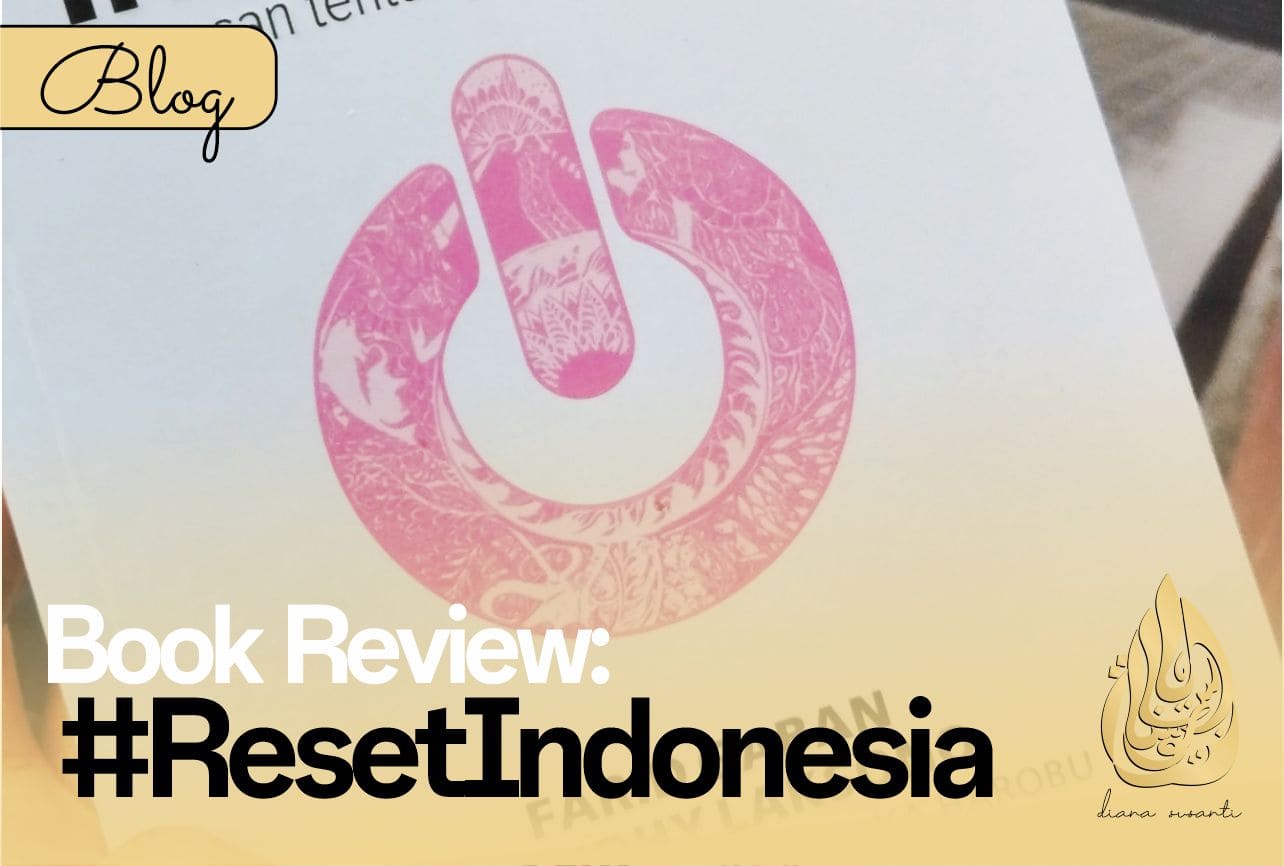
- Title: #Reset Indonesia: Gagasan tentang Indonesia Baru
- Author(s): Farid Gaban, Dandhy Laksono, Yusuf Priambodo, Benaya Harobu
- Publisher: Komunitas Bambu / Patjar Merah (2025)
- ISBN: 978-979-775-347-4
- Genre: Non-fiction, Essay, Journalism
- Structure: prolog + 6 bab + epilog
- Lenght: xii + 448 Halaman
First Impressions
I’ve been following Dandhy Laksono’s works and tweets for a while now, though I’ve only watched Sexy Killers (2019) and Dirty Vote (2024). There’s something unmistakable about his approach: critical yet compassionate, sharp yet always on the side of the marginalized. When mass protests erupted in Jakarta in August 2025, I happened to be there. Not far from the crowd, I saw faces filled with both rage and hope. That moment peeled away layers of systemic rot I’d only witnessed through a screen. Weeks later, back in Al Ain, my curiosity hadn’t faded. Amid the noise of Twitter debates came news that Dandhy and his team were launching a book called #ResetIndonesia. I knew I had to read it.
When the book finally landed in my hands, the first impression was strong: thick, 448 pages, elegantly bound, radiating a serious yet inviting aura. The table of contents alone promised structure and intent. Six chapters framed by a prologue and epilogue. Four authors across generations: Farid Gaban (boomer), Dandhy Laksono (Gen X), Yusuf Priambodo (millennial), and Benaya Harobu (Gen Z), blending their voices without discord. The result is a rare harmony, a cross-generational symphony envisioning Indonesia’s future.
The prologue begins by grounding the narrative in a concrete and urgent reality: the crisis of water access across the Indonesian archipelago. Through accounts of three major expeditions, it traces not only the physical movement across rivers, coastlines, and remote communities, but also a deeper intellectual journey into the foundational questions of development and justice. The aim is clear: to expose how something as basic and universal as water reveals the structural failures of governance, inequality, and extractive policy.
That said, the opening moves at a deliberate pace. The philosophical and historical framing is dense, and at times slows the narrative before it fully gathers momentum. Yet beneath that heaviness lies a purposeful attempt to decolonize our understanding of Nusantara, urging readers to see the nation not through inherited colonial abstractions but through lived ecological and human realities. The prologue isn’t merely descriptive travel writing; it lays the conceptual groundwork for imagining a fundamentally different Indonesia.
One of the most striking parts is the introduction of Gunter Pauli’s Blue Economy concept. It’s not foreign to Papuan communities who’ve long lived in balance with nature. But presented systematically, the idea feels like a breath of fresh air in a world obsessed with voracious growth. An economy modeled after nature’s wisdom, turning waste into value, guided by the principle that enough is enough. It’s not utopia; it’s a challenge to imagine productivity without destruction.
From there, the book flows through six main chapters, each exposing a different facet of Indonesia’s contradictions.
Chapter Summaries
Chapter 1 – How Low Can You Go

This is strongest part of the book: A piercing critique of development’s paradox: a nation rich in resources yet poor in direction. The authors dismantle the fragile myth of “Golden Indonesia,” the debt traps, and deindustrialization that keep the country digging its own grave. The arguments hit hard, grounded in data and field observations but anchored in humanity. Local voices are foregrounded; progress isn’t measured in GDP but in dignity.
Chapter 2 – Ada Dunia Lain (Lit: There Is Another World)
An exploration of alternatives to predatory capitalism: people-centered economies, Universal Basic Income, agrarian reform, and social solidarity. The authors invite readers to imagine a society that values collective happiness over competition. This “other world” isn’t fantasy; it’s the latent potential within Indonesia’s own social fabric.
Chapter 3 – Ekonomi dari Alam (Lit: Economy from Nature)
Here, the focus shifts to nature as a source of sustainable prosperity. From food systems and renewable energy to community tourism, the chapter demonstrates that true wealth doesn’t require ecological sacrifice. There’s an almost spiritual ecology at play: humanity not as dominator but as caretaker.
Chapter 4 – Alam terkembang jadi Guru (Lit: Nature as Teacher)
This chapter centers education and knowledge as the keys to real freedom. The writers highlight affordable education, women’s emancipation, and even hacker ethics as emblems of independent learning. Nature becomes a metaphor for continuous evolution, not memorization, but metamorphosis.
Chapter 5 – Kota untuk Semua (Lit: A City for All)
A fierce critique of soulless urbanization. Cities, they argue, shouldn’t be capitalist machines that exclude their citizens but shared spaces balancing rural-urban relations. The idea of “Pancasila on the Streets” appears here, a public ethic restoring togetherness in sterile, individualistic urban life.
Chapter 6 – Reset Indonesia
The final chapter calls for a total reconstruction of the society and governance. Democracy must return to the people, not remain an elite carnival. The authors advocate for local parties, genuine autonomy, and indigenous rights. The vision is bold: an Indonesia that is just, ecological, and egalitarian. In an era of centralization under policies like the Omnibus Law, the decentralist tone feels both radical and necessary. Though in practical term, still a bit questionable.
Analysis and Evaluation
What sets this book apart is its refusal to stop at criticism. It offers concrete alternatives: ideas, abstract mechanisms, frameworks to restore social and ecological balance. That courage to go beyond rhetoric makes it stand out among the usual political reads that drown in complaint. The strongest part of the book lies in its opening chapter, “How Low Can You Go,” which delivers a devastating yet lucid diagnosis of Indonesia’s current trajectory. It exposes the structural failures of the regime with precision, dismantling myths of progress and “Indonesia Emas” through data, grounded reporting, and unapologetic moral clarity. The chapter’s articulation of systemic decay: from deindustrialization and extractive economics to state capture and the collapse of agrarian and maritime sectors, is compelling and convincingly argued. It also introduces forward-looking concepts such as Gunter Pauli’s Blue Economy, framing them not as abstract utopias but as practical counter-visions rooted in ecological intelligence and productive balance. In that sense, the book begins with remarkable strength: sharp, well-researched, and courageous in naming what others often obscure or soften.
Still, it’s not flawless. It sometimes idealizes local communities as if they’re frozen in harmonious tradition. In reality, many have been pulled into the same modern vices: debt, materialism, ecological apathy. The book doesn’t fully confront how to “reset” a spiritually adrift society, or how to keep local elites from monopolizing autonomy.
Like in the “Desa Adalah Kunci” sub-chapter (Bab 6: Reset Indonesia, page 385) builds a compelling historical and moral case for rural revitalization, but it tends to romanticize the village as an inherently cohesive, cooperative unit waiting to be empowered. The narrative leans heavily on success stories from Bali, NTT, or Sulawesi, then quietly universalizes them as if they represent the baseline condition of Indonesia’s perdesaan. That’s where the argument wobbles. Many villages today are shaped by fractured social relations, uneven power structures, land commodification, and elite capture that blunt the very communal instincts the chapter celebrates. Some rural communities function less like resilient social organisms and more like microcosms of the same extractive logic the book criticizes at the national level. By glossing over these variations, the chapter risks presenting a blueprint that fits only the most cohesive villages, while leaving out those where local governance, ecological stewardship, and collective decision-making have already been compromised.
A similar weakness appears in the sub-chapter “Federalisasi, Siapa Takut?” (page 371), which promotes radical decentralization as the pathway out of structural inequality. The argument is constructed through geographic narration, political history, and inspiring examples of local resistance, but ultimately stops at the level of moral exhortation without addressing the most crucial operational challenge: how to prevent new concentrations of power at the local level. The assumption that broad autonomy will naturally produce justice relies heavily on the idea that local communities will always be rational, cohesive, and collectively oriented. In reality, many regions reveal patterns of patronage, vote-buying politics, licensing mafias, and the co-optation of customary institutions that are no less problematic than Jakarta-centric centralism. Without accountability mechanisms, fiscal transparency, and institutional guardrails against elite capture in the regions, federalism risks merely shrinking the scale of the inequality pyramid rather than dismantling it. At this point, the chapter reads more like a normative manifesto than a realistic roadmap.
That reflection matters, because that’s where the real challenge lies: awakening a new consciousness in a society exhausted by moral slogans and empty promises.
Conclusion
In the end, #ResetIndonesia remains a significant contribution to contemporary socio-political discourse in Indonesia, particularly for the clarity and force of its opening diagnosis in Bab 1: How Low Can You Go. Few works outline the structural failures of the nation with such precision, or articulate the urgency of systemic transformation as compellingly. For that alone, the book demands attention and deserves recognition for stirring public imagination at a time when apathy often wins.
Yet having sat with the text longer, the initial admiration gradually gives way to a more sober evaluation. Beyond its powerful critique, many of the proposed pathways forward drift into the territory of aspirational rhetoric rather than feasible strategy. The solutions presented in the later chapters lean heavily on idealized visions of community and decentralization, but stop short of addressing the harsh political and social realities that sabotage such ideals: fragmentation, elite capture, institutional fragility, and the erosion of collective values. Without confronting those obstacles, the book’s call to “reset” risks feeling more symbolic than structural.
#ResetIndonesia is strongest as reflection and provocation, less so as blueprint. It ignites questions that matter, but does not fully resolve the complexities it raises. Perhaps that is its unintended message: that resetting a nation requires more than moral courage and imaginative proposals; it demands mechanisms that can withstand human frailty, power struggle, and historical trauma.
At this stage, the most honest evaluation is mixed. Inspired by its opening, unsettled by its conclusions, and ultimately aware of the distance between vision and reality, I now place this work at 2.6 out of 5. Not because it lacks passion or intelligence, but because its solutions feel unanchored from the terrain they hope to transform.
Even so, the book remains a mirror, asking whether we are willing to confront the world as it is instead of how we wish it to be, and whether we are prepared to rebuild from the ruins with clarity rather than hope alone.
No ivories with no crack. Wa Billahi Tawfiq wal Hidayah, Hasbi Rabbi Jalallah.
Wa Assalaamu ‘Alaykum Wa Rahmatullahi Wa Barakatuh
